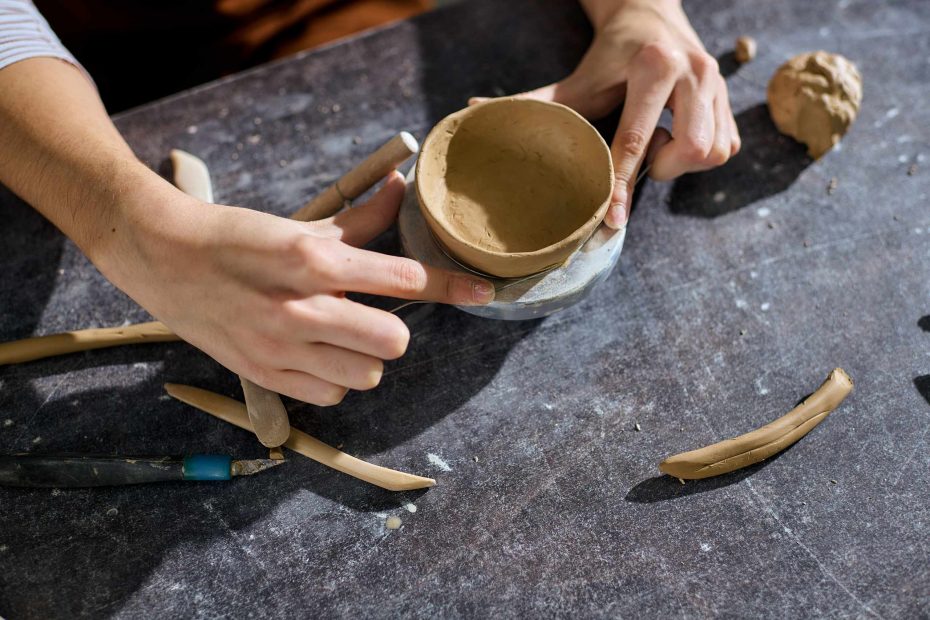
Knowing when your clay is wet, dry, and workable is crucial. Wet clay can be sticky, pull on your work board, crack at the edge, and will fall apart if you try to pick it up. All of these are clues to tell you how ready the clay is to be worked. This will take practice but it’s more of a sign of a good modeler than a certain time of day. For instance, a given clay body might be too wet for pinching one day and too wet (after re-wetting) and too dry (when left too long in the uncovered open) after several days of hand building. The ability to know your clay body’s level of wetness is a very valuable skill to learn for beginners.
Wet clay is usually shiny, sticky and hard to work with. If you press your finger into it, it won’t hold its shape and tends to smear out on its own. A pinch pot made from clay that is too wet may start to sink from the very top and may lose the rim. A slab will stretch on itself when you move it. A coil may flatten more than round itself up. Adding more water will help it in the beginning but over time, it will only make it more soft, weak, and likely to have marks made from fingers accidentally touching it.
Dry clay is also usually easy to identify. If you try to bend it, it will crack. If it is too thin on an edge it will crumble and not hold together. Trying to join a small handle, coil, or decoration to clay that is too dry may cause it to rip at the seam where it joins to the rest of the form as the surfaces will not adhere as easily. If the rim of the form is too dry when you are trying to tuck or tuck in it you may end up with a rough texture. Trying to force a form through this stage, especially around edges, corners, and thin walls is going to lead to issues for your project.
Clay that is ready to be shaped is neither of the above. It’s soft enough to be manipulated with pinches, rolls and cuts, and firm enough to maintain a small change in shape. A good pinch pot will allow gradual forming and won’t cause the walls of the pot to drop down from a wet point. A good short coil will roll without cracking on the outside or becoming flat. A good slab form will move off the board when you pick it up and won’t stretch. You’re able to leave a nice impression in it with your thumb, finger or tool, and you can smooth a piece and not end up with muddy marks and wet texture.
An exercise to try is to take a little bit of clay and divide it into three pieces. Cover one piece and add a little water to another, then leave the third one out for a while. Take your thumb, press in it with the same amount of pressure and look at the marks you are making. Roll the clay in a little short coil. Take a wet sponge and smooth the clay and then a wooden tool to check out the texture difference as you get older. Your goal is not to be working on making a great piece of work, but to start understanding what the clay needs to give it more.
As you’re building a piece, stop often to check on the wetness of your clay, before you start building two pieces together, check that they feel similar in wetness before you build up a form on top of the first, before you cut into your slab, check the edge to see whether it’s cutting cleanly or tearing, and before you are building up on top of another form, check the form that it doesn’t bend when you push onto it with a tool. These little checks can help you prevent beginner problems such as seams breaking too easily, bottom edges of pots that slump under, or rim textures that lose their shape as you’re working.
The biggest sign of improvement will not be that you never get clay issues, but that you start seeing that problems happening. Maybe you are noticing that you’re adding too much water to the bowl and making the surfaces too slick, or you’re remembering to cover that piece up before it dries out, or you’re taking a moment to try smoothing again before going over it once more. Clay becomes easier to work with when you start to treat it not just as a material but also as something that changes with your manipulation.